Missed calls: how much money are you really losing?
A plumber working alone can lose close to 39,000 € a year to unanswered calls. The numbers for four trades, why your customers call, and how to stop letting a single one get away.
In short
- One call in four with nobody on the line: that is what the French consumer group UFC-Que Choisir measured in 2023 across 2,642 GP practices, even though many of them have a secretary.
- Missing one call in four, a plumber loses about 39,000 € a year, a chiropractor 29,000 €, a locksmith 25,000 €, an electrician 11,700 €.
- Most calls are simple: appointments (44%), opening hours (44%), availability (42%), prices (34%), according to Google and Ipsos.
- 39% of people go elsewhere if they can't reach you by phone.
- An agent that picks up for you handles the simple calls and sends you a summary of the rest. More and more owners count their AI agents the way they count their vans.
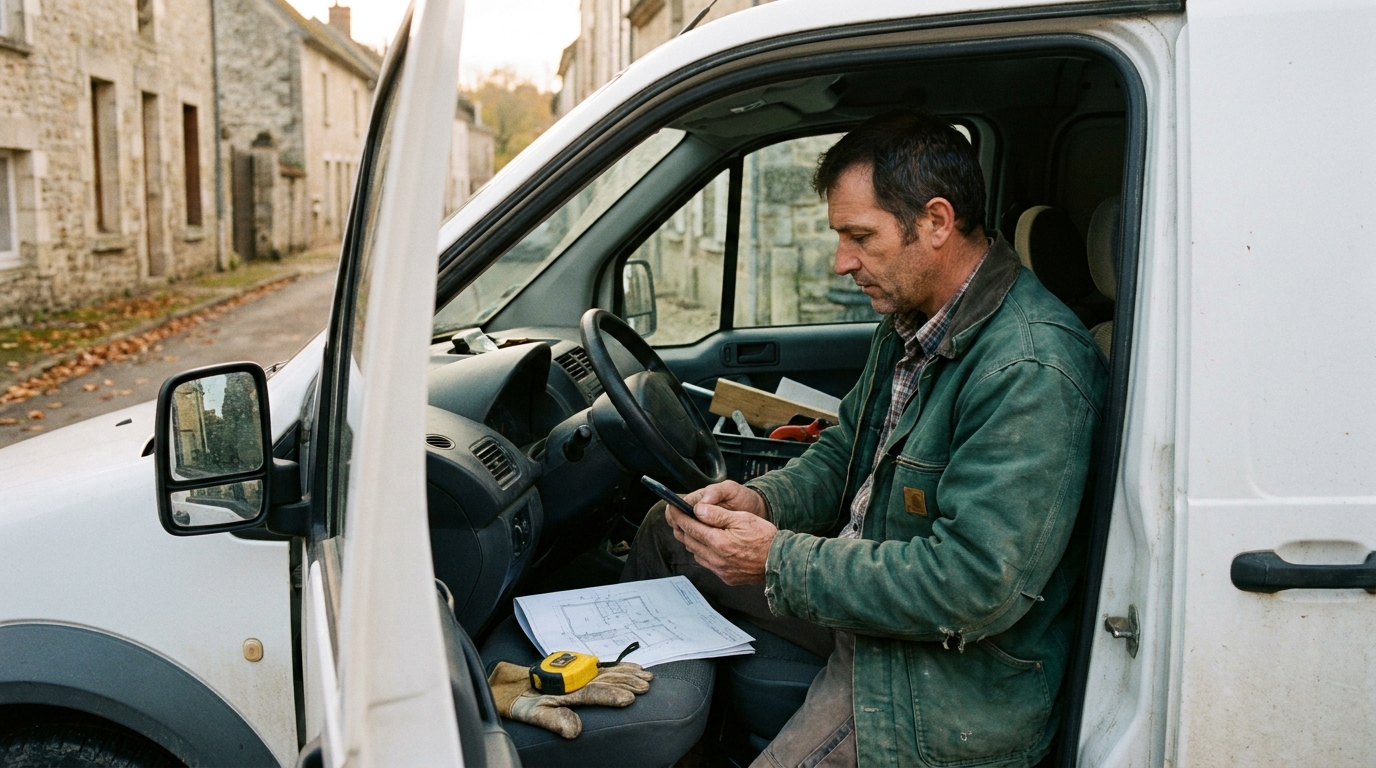
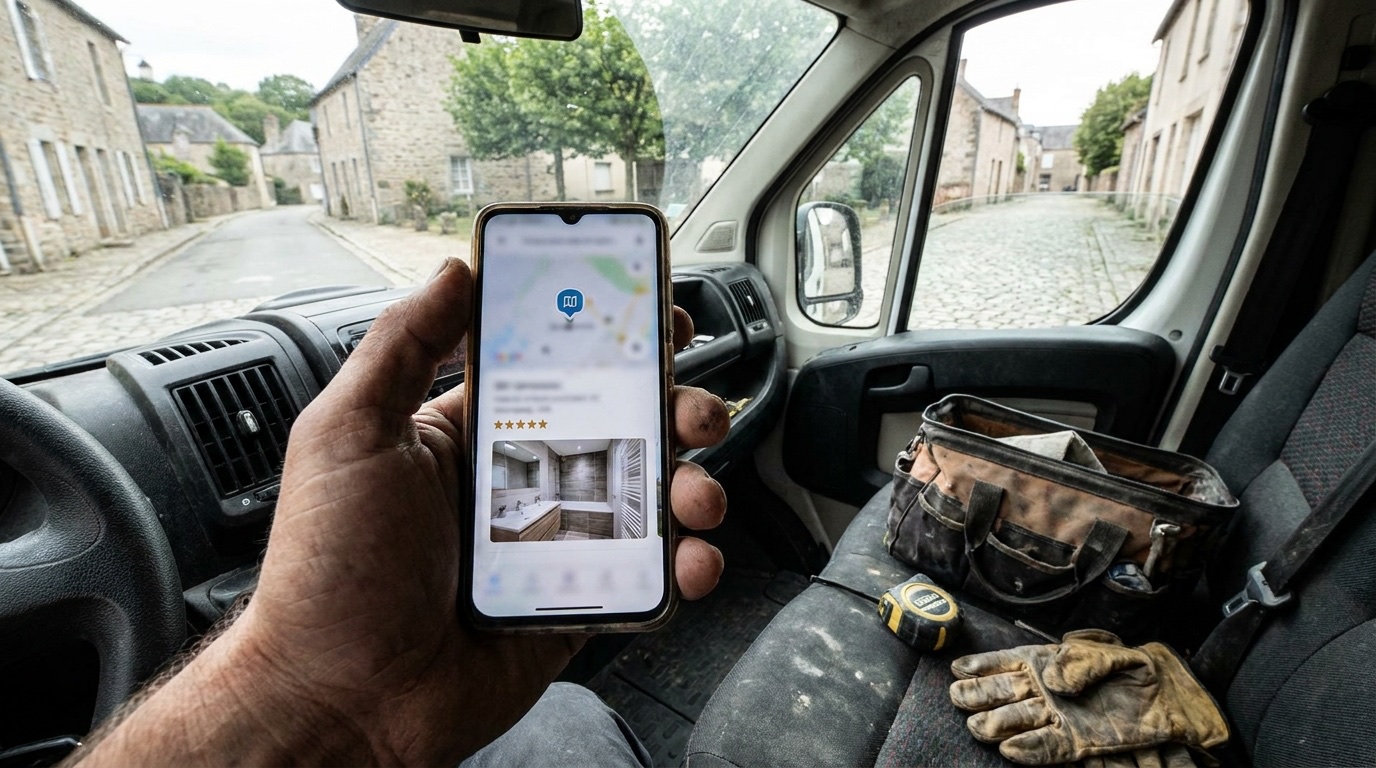
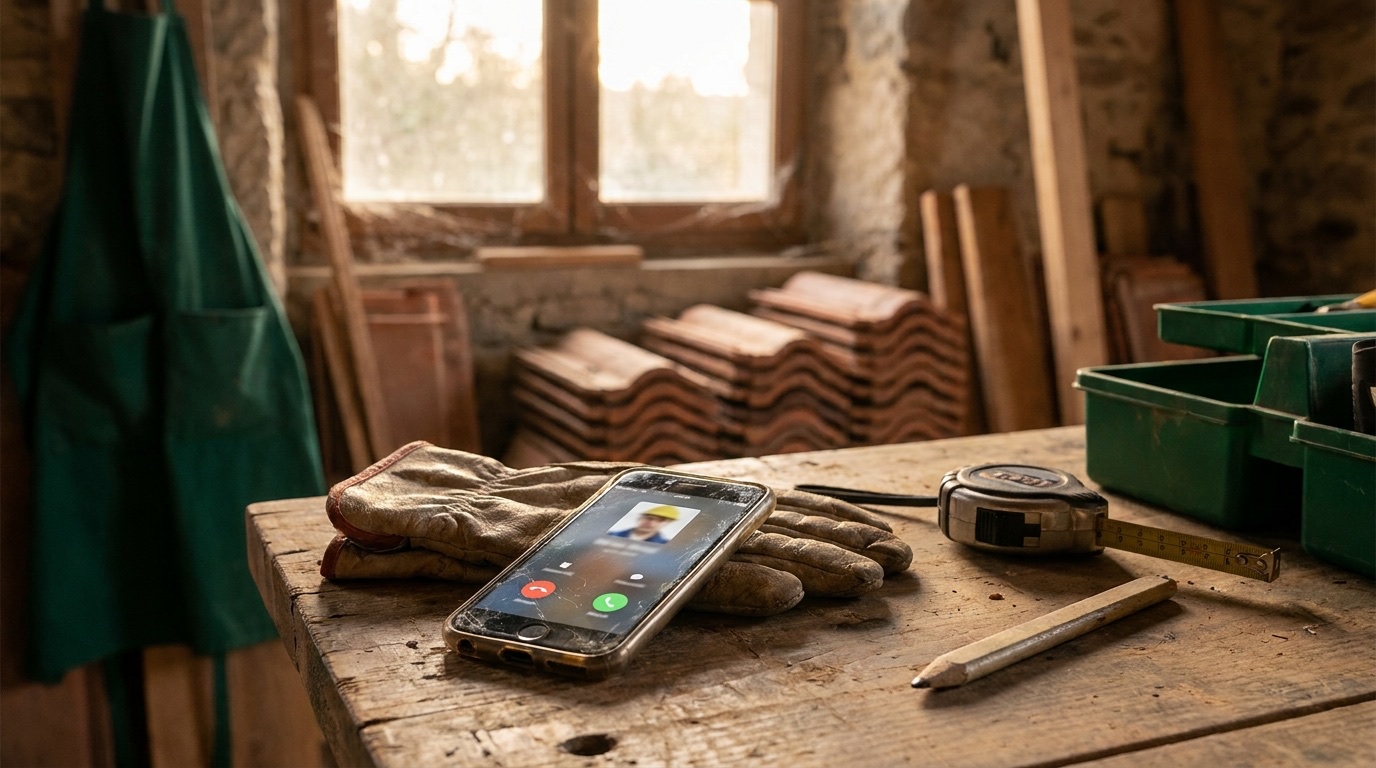
Tuesday, 3 pm. You're up on a roof in Senlis with both hands busy. The phone buzzes in your pocket. By the time you're back down, the call is gone, and there's no message. Maybe it was a supplier. Maybe it was a full roof renovation, and that customer has already called the next roofer.
Missed calls cost money for every tradesperson and shopkeeper who works with their hands. The real question is how much. For a plumber working alone, our calculation comes to about 39,000 € a year. Here's where that number comes from, what the people calling you actually want, and how to stop losing those customers.
How many calls go unanswered?
The figure you see most often online is 62%. It comes from a US agency, 411 Locals, which tracked the calls of 85 small businesses for 30 days in 2016. Only 37.8% of calls were answered. 37.8% went to voicemail, and 24.3% got no answer at all. And 70% of the businesses tracked answered fewer than half of their calls.
In France, the most solid measurement comes from the consumer group UFC-Que Choisir. In 2023, it called 2,642 GP practices: in one case out of four, nobody was on the line. Many of these practices have a secretary, a remote answering service or an answering machine. A tradesperson alone on a job or a hairdresser alone in the salon doesn't do any better.
Those who get organised improve fast. French public services, which have tracked their answer rate since the French government's Plan téléphone, went from answering 77.6% of calls in 2023 to 81.8% in 2025. The Assurance Maladie, France's national health insurance, went from 68% to 86%.
Why your customers call you
Google had the research institute Ipsos measure why people call a business after searching on their phone. The European edition of the survey, carried out in Italy among 1,500 smartphone users (2014), gives this ranking:
| Reason for calling | Share of people |
|---|---|
| Book an appointment or make a reservation | 44% |
| Find out the opening hours | 44% |
| Check whether the service is available | 42% |
| Ask for or compare a price | 34% |
| Ask to be sent information | 28% |
| Find the address or directions | 27% |
The number one reason to call rather than visit the website: getting a quick answer (55%). And 4 users in 10 say they often need to call a business directly from their search results.
Real call data points the same way. The US AI receptionist company NextPhone analysed almost 1.45 million calls to small businesses in 2025: one call in two (51%) came from a potential customer, and 28.5% arrived outside business hours. The rest is mostly routine: general questions (32%), callback requests (29%), questions about a service (11%), booking an appointment (8%). Most calls don't need your expertise. They need someone who picks up, knows your hours and your calendar, and writes the request down.
And when nobody picks up? In the same Google survey, 39% say they'll go to another business if they can't call you, and 38% say it annoys them. In the US, 78% of consumers surveyed by CallRail in 2025 say they have already given up on a business after an unanswered call. Yet the phone is still the reflex: 65% of Britons contact businesses by phone, according to YouGov (2025).
How much money you lose: the numbers by trade
We ran the numbers for four trades. Prices come from French public price guides from 2026. For the rest, we used realistic assumptions for someone working alone or with one other person, missing one call in four. Swap in your own figures and the principle stays the same.
| Plumber | Locksmith | Electrician | Chiropractor | |
|---|---|---|---|---|
| Calls per week | 40 | 30 | 30 | 40 |
| Missed calls (1 in 4) | 10 | 7 to 8 | 7 to 8 | 10 |
| Of which new customers | 50% | 80% | 50% | 40% |
| Never reached afterwards | half | two in three | half | half |
| Would have signed or booked | 60% | 80% | 60% | 80% |
| Value of a new customer | 500 € | 150 € | 200 € | 350 € (5 sessions at 70 €) |
| Customers lost per week | 1.5 | 3.2 | 1.1 | 1.6 |
| Loss per month | about 3,250 € | about 2,080 € | about 975 € | about 2,430 € |
| Loss per year | about 39,000 € | about 25,000 € | about 11,700 € | about 29,000 € |
The plumber: every unanswered leak goes to the next plumber
The guide from La Maison Saint-Gobain, a French home-improvement site, advises budgeting a flat 500 € for clearing a blockage or fixing a leak, with hourly rates of 40 to 140 €. Someone with water on the kitchen floor won't wait for you to come down from the job: they call the next one. And the table only counts call-outs. A customer who was happy with an emergency repair often comes back for the water heater or the bathroom.
The locksmith: nobody waits on the doorstep
According to the French insurance site Goodassur, a simple door opening costs on average 90 € in Lille, 120 € in Lyon and 150 € in Paris, and around 150 € at night. Replacing a 3-point lock is billed at 400 to 800 €. Someone locked out doesn't leave a message: they call the next number on Google. In this trade, a missed call is almost always a lost customer.
The electrician: a power cut won't wait until evening
According to IZI by EDF, the home-services platform of the French utility EDF, an electrician charges on average 75 € per hour excluding VAT, and tracing a total power failure starts at 200 € before parts. Nobody without power waits patiently until 7 pm. A fault fixed well also brings a customer who calls you back when their wiring needs bringing up to code.
The chiropractor: a new patient means several sessions
According to Selectra, a session in France costs 35 € outside the big cities and 60 to 80 € in the big cities. During a session, the practitioner doesn't pick up. A patient who can't get through to the practice books somewhere else, and all the following sessions go with them. That's why we count the value of a patient, not of a single session.
American videos talk about losses of up to $34,000 a month. You don't need to go that far: with reasonable assumptions, a tradesperson working alone already lets 1,000 to more than 3,000 € a month slip away. These are customers who were looking for you, had your number and wanted to pay you.
What you gain when every call gets an answer
Answering every call doesn't have to mean picking up yourself. What matters is that no caller is left hanging. In practice, here's what changes in your week.
- You finish your work. You stay on the roof, at the wash basin or in the kitchen, without running to the phone every time it rings.
- The customer gets an answer right away. They hear a voice that takes down their request or offers them a slot, instead of a phone that rings out. They have no reason to call the next name on the list.
- You call back knowing what it's about. Name, town, type of work, urgent or not: you get a written summary, so you never have to call an unknown number back blind.
- Emergencies come first. A water leak or a power cut is flagged to you straight away. The quote for next spring can wait quietly until the evening.
- Evenings and weekends stop piling up. When you get home, the requests are already sorted, instead of fifteen voicemails to listen to one by one.
- You finally see your numbers. How many calls, at what time, about what. Like the French state with its answer rate, you know where you stand.
“How many agents work for you?”
For a long time, people asked a tradesperson how many vans or workers they had. Today you hear another question more and more often: how many AI agents work for you? Small business owners say it with pride: “I've got five agents working for me.”
It might make you smile, but it's a number as concrete as the number of vehicles. An agent is a program that does one specific task for you, every day, without a break. For example:
- an agent that answers the phone when you can't;
- an agent that answers questions in your website chat in the evening;
- an agent that takes appointments and puts them in your calendar;
- an agent that asks every happy customer for a Google review;
- an agent that follows up on quotes that got no reply.
When someone tells you how many agents they have, the smart move is to ask what each one does. An agent without a specific task doesn't count. Five agents, each with a clear job, make a small team that never takes a holiday.
Those who start now get ahead: according to Eurostat, only 17% of small European businesses with 10 to 49 employees used AI in 2025. Among German tradespeople, it was 4%, according to Bitkom.
Your own number in 7 days
It costs nothing: your phone already keeps almost everything in its call log.
- Pick a normal week, not a holiday week and not one with an unusual job.
- Every evening, open the call log and note the day's missed calls: the time, and whether the caller left a message.
- Note what you did next: called back the same day, called back later, or didn't call back at all.
- When you call back, note what the person wanted: new customer, existing customer, supplier or sales call. A missed sales call isn't a loss.
- Also count the ones you called back but never managed to reach.
- At the end of the week, work out three totals: missed calls, the ones from new customers, and among those, the ones you never got on the phone.
If you have a landline at the office or the salon, do the same with its voicemail. The third total, new customers you never reached, is your real number.
Then run the numbers with your totals: new customers never reached × share of your quotes that you win × average value of a customer. Multiply by four for a month.
What to do with the calls you can't take
- A voicemail greeting that makes people want to leave a message: your name, your trade and a promise you keep, “I'll call you back before 7 pm”.
- An automatic text message after a missed call, something like “I'm on a job, I'll call you back today”. The caller knows they've been heard.
- Online booking for requests that aren't urgent. The customer picks a slot themselves, even at 11 pm. We explained this in our article on online booking.
- An AI phone answering service: a voice agent that picks up when you can't, says it's an AI, takes down the request or books the appointment, and sends you a written summary.
The right choice depends on your number. A plumber who misses emergencies doesn't have the same problem as a landscaper who misses quote requests for the spring.
What to take away
One missed call in four is a common order of magnitude, even at practices that have a secretary. Most of those calls are simple: an appointment, opening hours, availability, a price. And each one could be a customer who was looking for you. For a plumber, a locksmith, an electrician or a chiropractor, that adds up to 11,700 to 39,000 € a year in our examples.
At opencream.studio, the AI phone answering service is one of the agents we set up: it picks up when you can't, answers simple questions, books appointments and sends you a summary of every call. It's set up for your business, with your hours, your services and the questions you get asked most, and it comes on top of a website for tradespeople and local businesses that stays yours. For the technical side, our article on opencream.ai explains how a phone agent works and what to measure.
Your questions
How many calls does a small business miss?
Why do customers call a business?
How much does a missed call cost a tradesperson?
Is a customer who reaches voicemail lost?
What does “I've got five agents working for me” mean?
Want to be easier to find?
Ask for a free quote or call us.
Not ready yet? Check your visibility in 1 minute