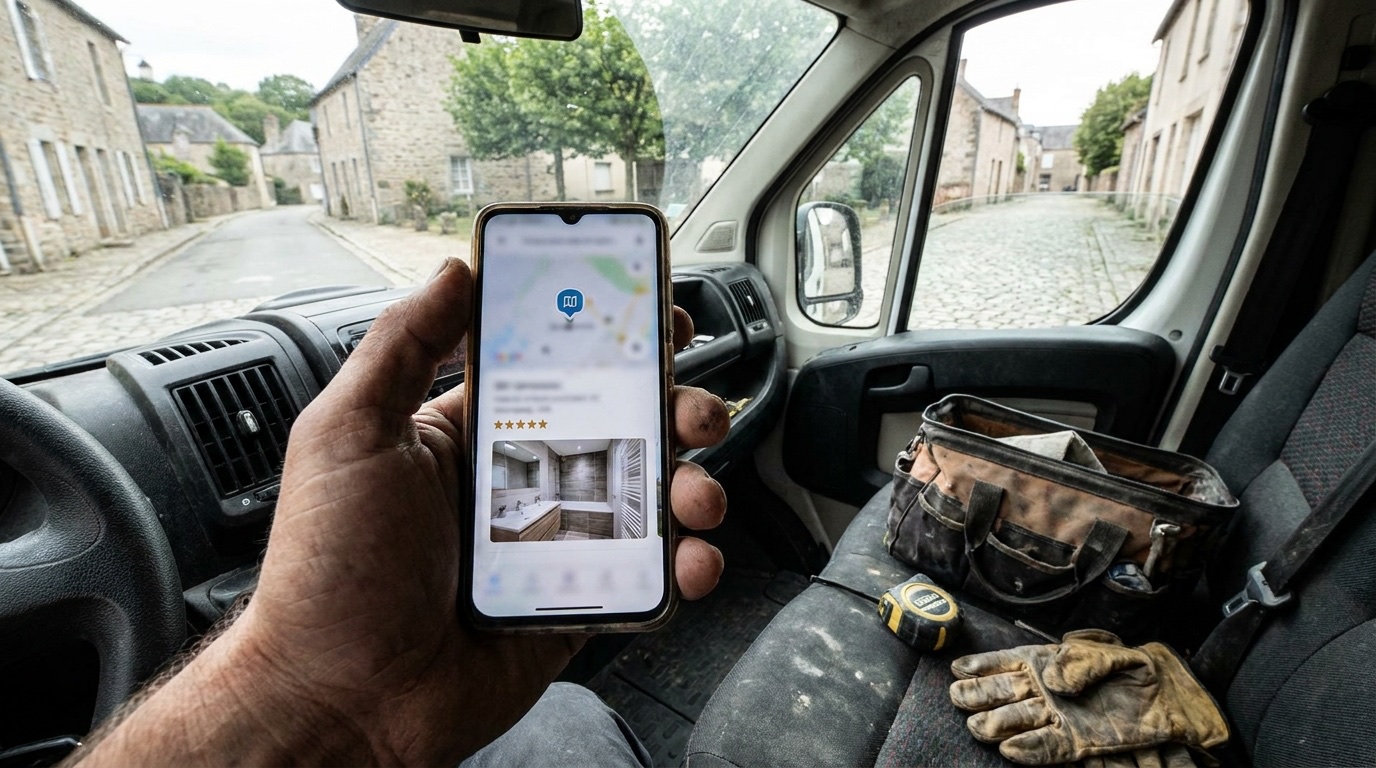
A customer wants to book you at 11 pm: can you answer?
Your customers book the doctor and the hairdresser at 10 pm. What a tradesperson can offer online, and how to stay in control of the diary.
In short
- On Planity, half of online appointments are booked outside salon opening hours, according to the platform. On Doctolib, it was already 30% in 2017.
- Whoever answers first has a head start: in a US study of 1.25 million enquiries, contacting the customer within an hour made a real conversation nearly seven times more likely.
- Online, offer a 15-minute first call or a site visit. Quotes and emergencies stay on the phone.
- You stay in control: limited slots, travel time between appointments, minimum notice, a daily maximum.
- A short form, an instant confirmation and two reminders are enough.
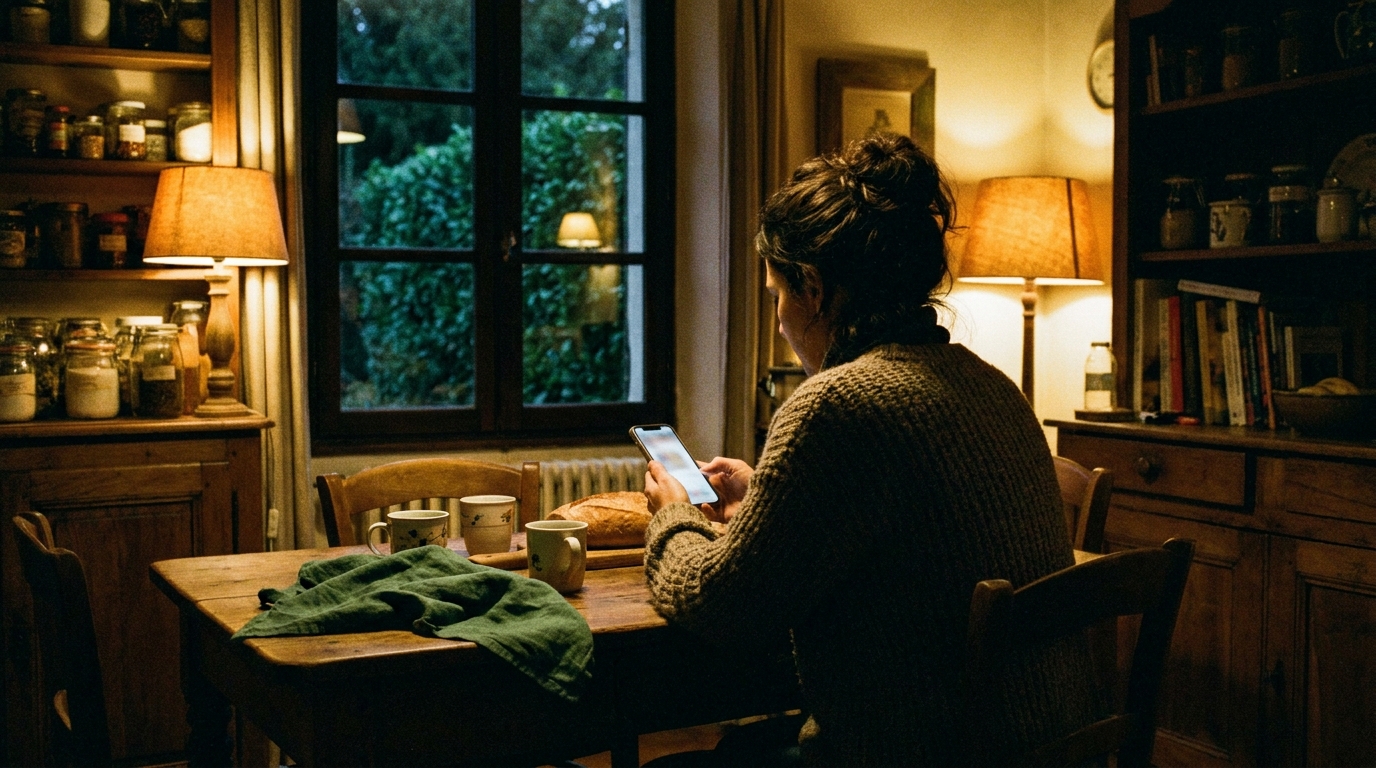
It's 11 pm in Gouvieux and the children are finally asleep. A woman looks at the hedge that has taken over the end of the garden and types « paysagiste Gouvieux » (landscaper Gouvieux) into her phone. She opens three websites. The first shows a phone number, but she isn't going to call a tradesperson at this hour. The second has a contact form. The third lets her pick a slot straight away: a visit on Thursday at 6 pm.
She books in thirty seconds and goes to bed. The next morning, she has forgotten about the other two.
Online booking is now normal at the doctor's and the hairdresser's. For a tradesperson, the question is simpler than it looks: what to offer online, and how to stay in control of the diary.
Your customers are used to booking straight away
Your customers order on Amazon at midnight, get dinner delivered by Uber Eats, book the doctor on Doctolib and the hairdresser on Planity. Each time, they pick a slot when it suits them, often in the evening, and get a confirmation within a minute.
The platforms publish a few figures. Planity, the booking tool used by French hair and beauty salons, says on its website that 50% of online appointments are booked outside opening hours. Back in 2017, Doctolib, France's main medical booking platform, presented a figure of 30% of appointments booked outside surgery opening hours. These are the platforms' own numbers, and they have every reason to promote them. Still, they point the same way: many people book when the surgery or the salon is closed.
And they do it on their phones. According to the 2026 Digital Barometer from Arcep, the French telecoms regulator, 91% of people aged 12 and over in France own a smartphone.
For tradespeople, we found no reliable public figure on evening bookings. But your customers are the same people. Someone who booked the dentist at 10 pm sees no reason to wait until 8 am the next day to ask a painter for a visit.
The phone still has its place. A water leak, a power cut, tiles blown off by the wind: the customer calls, and rightly so. Online booking is for everything else, the projects that can wait a few days but where the customer wants to get moving now.
Whoever answers first has a head start
When customers look for a tradesperson in the evening, they rarely contact just one business. They fill in two or three forms, or ask ChatGPT for a short list of names, as we saw in our test of AI assistants. The next day, they talk first to whoever calls back.
There is no French study on how quickly tradespeople respond. The most quoted reference comes from the United States. In 2011, three researchers published a test of 2,241 companies in the Harvard Business Review: 37% answered an online enquiry within an hour, and 23% never answered at all. In a second study of 1.25 million enquiries, companies that contacted the customer within an hour were nearly seven times more likely to have a real conversation with them than those that waited just one hour longer.
These are American companies, not tradespeople in the Oise, and the study is fifteen years old. The logic still holds: an enquiry goes cold quickly.
On a job site, you can't answer within the hour. That's where online booking helps. The customer gets an answer straight away, in the form of a confirmed slot, even if you're up a scaffold or already asleep. Then you call or visit at the time they chose.
What you can offer online
The quote is still your job. Online, the customer only books the first step, the one that helps you understand the project.
A 15-minute first call
This is the easiest to set up. The customer picks a slot and you call at that time. In a quarter of an hour, you know whether the job is for you, whether it's in your area and whether a visit is worth the trip. It works for almost every trade: electrician, plumber for a bathroom, carpenter, mason.
A site visit
For a landscaper, a painter or a roofer, the real first step is the visit. You open a few slots a week, at the end of the day or on Saturday morning, each of a fixed length. The customer gives the address when booking, and you can see right away whether it's on your way.
What stays on the phone
Emergencies, big projects that need a conversation even before a visit, and customers who prefer to call. Keep your number clearly visible next to the booking button, for those who want to talk straight away.
If you have a Google Business Profile, Google also lets you send customers to your booking links from it. A customer who finds you on Google Maps can then book without looking any further. We explained what the profile does in our article on the Google profile and the website.
How to stay in control of your diary
The fear we hear most: ending up with six visits on the same day, at opposite ends of the département. A well set-up booking tool prevents that. These are the settings that matter.
- Limited slots. You open only the times you want, for example Tuesday and Thursday from 5 pm to 7 pm. The rest of the week doesn't show.
- Time between appointments. Allow for travel and a margin. A visit in Senlis and another in Chantilly straight after, with no gap, doesn't work.
- Minimum notice. Nobody should be able to book a visit for two hours from now. With 24 or 48 hours' notice, you have time to plan.
- A short horizon. Open two to four weeks ahead, not three months. Your job schedule changes too fast.
- A daily maximum. One or two visits a day, and the rest of the time stays for the job.
- Your diary comes first. When you note a job, an appointment or a holiday in your calendar, those hours are no longer offered.
If an appointment doesn't suit you, you call the customer to move it. You keep the final say, just as on the phone.
What to ask in the form
The longer the form, the more people give up at 11 pm. Ask for what you need to prepare the appointment and nothing more. That's also the rule set by the CNIL, France's data protection authority: only collect data that is « adéquates, pertinentes et nécessaires » (adequate, relevant and necessary).
- Name.
- Phone number, to call back, and email, for the confirmation.
- The town or address of the job, to check it's in your area.
- The type of work, with a simple choice (hedge trimming, new garden, maintenance) and a free line for details.
- One or two photos if the customer has them, optional.
No date of birth, no compulsory budget, no ten-line questionnaire. You'll see the rest on site.
Confirmation and reminders
Once the slot is chosen, the customer should get a confirmation email straight away, with the date, time, address and your number. Ideally it includes a calendar invite and a link to reschedule or cancel themselves.
Then a reminder the day before and another one hour before. That's what saves you a wasted trip. In 2017, Doctolib claimed its service cut missed appointments by 75%. Again, that's the platform's own figure.
On your side, you get a message for each booking, and the appointment goes into your calendar. After the visit, it's also a good moment to ask every customer for a Google review, as we explain in our article on reviews.
Before you open online booking
An hour of setting up is enough. Go through the list:
- Pick one type of appointment to start with: the 15-minute call or the visit.
- Set your slots. Two or three a week are enough at first.
- Set the time between appointments, the minimum notice and the daily maximum.
- Write on the page what happens during the appointment, how long it lasts and whether it's free.
- Keep the form to five questions at most.
- Make a test booking yourself to see the confirmation and reminders.
- Add the booking link to your Google Business Profile.
- Keep your number visible for emergencies.
What we take from this
A customer who wants to book you at 11 pm doesn't expect you to pick up at 11 pm. They want it sorted before they go to bed. A slot they choose themselves and a confirmation within a minute are enough, and you call at the agreed time.
At opencream.studio, online booking is an option in the monthly subscription. Your customers pick a slot on your website, and it lands in your Google Calendar. We set the slots, the length, the time between appointments, the minimum notice and the daily maximum with you. The customer gets a confirmation with a link to reschedule or cancel, then a reminder the day before and one hour before.
It comes with a website for tradespeople built to be found on Google and in AI answers, for tradespeople and shops in Chantilly and the Oise. The domain name is in your name, the website belongs to you, and the subscription has no minimum term.
For a free quote, call 01 62 04 44 04 (+33 1 62 04 44 04) or write to us through the website.
Good work deserves to be found.
Your questions
Is online booking useful for a tradesperson?
Will I lose control of my schedule?
Can a customer book a quote online?
What if the customer forgets or cancels?
Do I need a website to offer online booking?
Want to be easier to find?
Ask for a free quote or call us.
Not ready yet? Check your visibility in 1 minute