Find a tradesperson with ChatGPT: are your customers doing it?
How many people in France already ask an AI to find them a tradesperson, and what ChatGPT, Gemini and Perplexity look at before they give a name.

In short
- In France, 48% of people aged 12 and over use an AI like ChatGPT, up from 20% in 2023 (Arcep, February 2026). To look something up, Google is still ahead: 59% against 28%.
- Since summer 2026, Google also shows answers written by AI at the top of the page, called AI Overviews (Aperçus IA in French).
- Our test on 7 October 2026: 5 trades, 5 towns in the Oise, 3 assistants (ChatGPT, Gemini, Perplexity). Every time, the AI gave the names of tradespeople.
- AI assistants cite the rating and the number of reviews first, then what they find written on your website or in directories: your trade, the towns you cover, emergency call-outs, certifications.
- None of them will recommend you if they can't find anything clear to say about you.
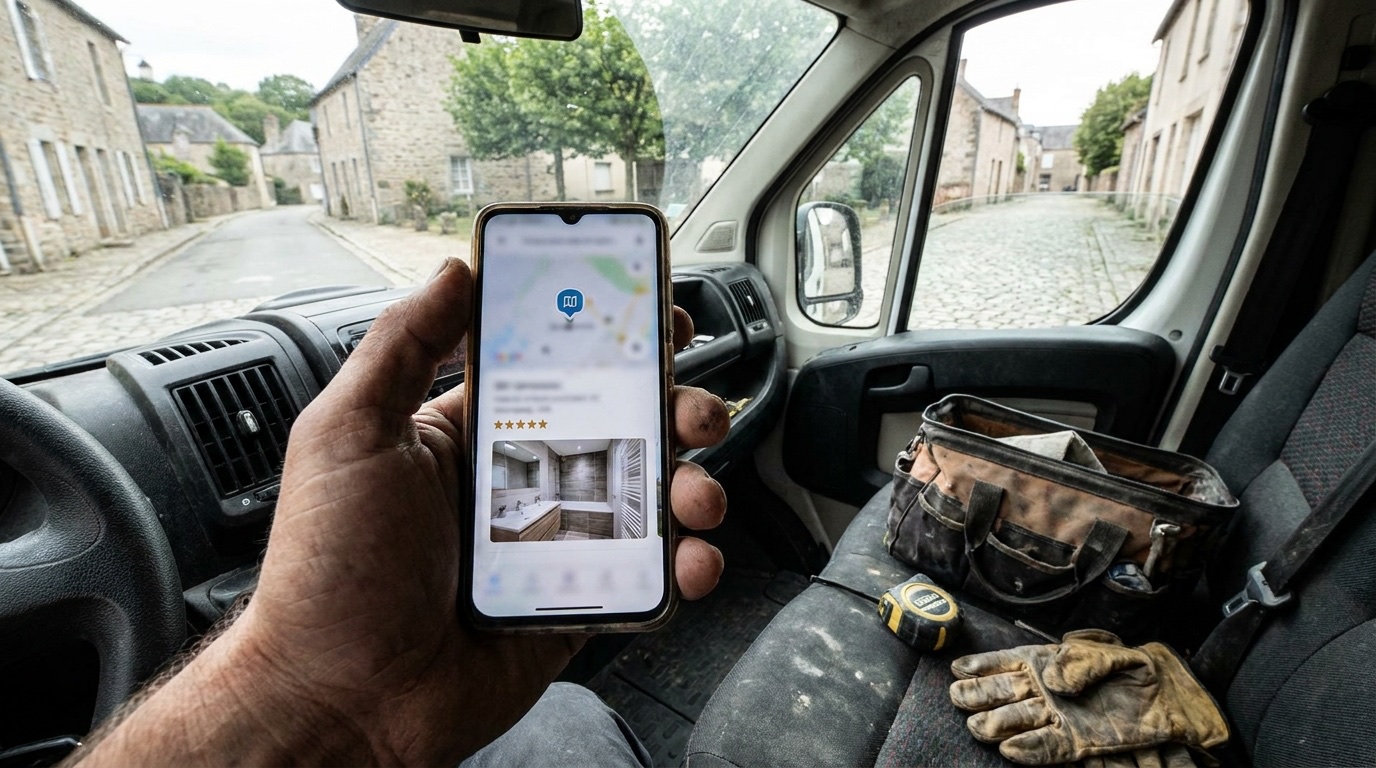
We asked ChatGPT this, word for word: « Je cherche un bon plombier à Chantilly, qui me conseilles-tu ? » (I'm looking for a good plumber in Chantilly, who would you recommend?). The answer came back in a few seconds. Three names, the distance from Chantilly, and for the first one: "4.9/5 from 101 Google reviews". No links to sort through, just a recommendation, much like one from a neighbour.
So you can find a tradesperson with ChatGPT. The open questions are whether your customers actually do it, and what the AI looks at to choose the names it gives.
How many people in France already search with AI?
The most reliable figure comes from the Baromètre du numérique by Arcep and CRÉDOC, published in February 2026 and based on more than 4,000 people. 48% of French people use generative AI, up from 20% three years earlier. Of those, 63% mostly use ChatGPT.
Médiamétrie points the same way: 56.6% of French people used at least one AI service in April 2026, and use of AI assistants grew by 34% in nine months.
To look something up, most people still go through a search engine. Again according to Arcep, 59% use a search engine and 28% use an AI. So Google keeps a clear lead, but more than a quarter of people already ask an AI.
What about tradespeople specifically? There is no reliable French figure yet. In the United States, BrightLocal's annual survey of 1,002 consumers found that 45% use ChatGPT or another AI tool to find a local business or professional, up from 6% a year earlier. Those are American figures. For France, the volumes below give you an idea.
We also looked at volumes. According to DataForSEO's estimate for France, the word « plombier » (plumber) is asked about roughly 18,900 times a month in AI assistants, against 60,500 searches a month on Google. Roughly speaking, a quarter of those questions already go through an AI. For « paysagiste » (landscaper), « couvreur » (roofer) or « électricien » (electrician), there are between 7,500 and 8,500 questions a month to AI assistants.
Google now answers with AI too
Even your customers who have never opened ChatGPT see AI answers. Since summer 2026, Google in France shows AI Overviews (Aperçus IA in French): a paragraph written by AI at the very top of the page, before the links.
We recorded Google's results on 7 October for about a dozen searches made from the Oise.
On practical questions, the AI Overview often appears. It did for 4 questions out of 7, including « fuite sous évier que faire » (leak under the sink, what to do), « combien coûte un ravalement de façade » (how much does a facade renovation cost) and « comment choisir un paysagiste » (how to choose a landscaper). The customer reads the answer, and sometimes doesn't need to click any more.
On "trade + town" searches, Google still mostly shows its business listings and the map. But not always. For « plombier chantilly », the AI Overview named four plumbers, with sources such as PagesJaunes, Mappy and the tradespeople's own websites. For « couvreur creil », it gave the address, phone number and specialities of several roofers.
These answers change from one day to the next and from one phone to another. The principle stays the same: the AI picks a few names and explains why.
Our test: 5 trades in the Oise, 3 assistants
On 7 October 2026, we asked five questions the way a customer would, with web search switched on:
- « Je cherche un bon plombier à Chantilly, qui me conseilles-tu ? » (I'm looking for a good plumber in Chantilly, who would you recommend?)
- « Quel électricien choisir à Senlis ? » (Which electrician should I choose in Senlis?)
- « Trouve-moi un paysagiste sérieux près de Compiègne » (Find me a reliable landscaper near Compiègne)
- the same for a roofer in Creil and a painter in Beauvais.
Each question went into ChatGPT, Gemini and Perplexity, so 15 answers in total.
All 15 answers gave names. ChatGPT suggested 3 to 5, Perplexity 3 to 6, Gemini 4 to 7. None of them said "go and look on Google". The customer gets a short list, and often calls the first name on it.
The rating and the number of reviews come first. The answers say things like "4.9/5 from 101 Google reviews" or "4.5/5 from 12 reviews". In our 15 answers, the tradespeople at the top almost all had lots of reviews. Someone with three reviews ranks behind someone with sixty, even if their work is better.
Each assistant has its own sources. ChatGPT cited PagesJaunes in all 5 of its answers, including to pick up the Google ratings shown on those pages. Perplexity relies heavily on directories and comparison sites (travaux.com, allovoisins and others), and also cites tradespeople's websites. Gemini cites the tradespeople's own websites first.
To describe a tradesperson, the answers pick up their specialities ("leak detection, hot water cylinders"), their availability ("emergencies 7 days a week"), their certifications (RGE, Qualibat, QualiPaysage), their address and their town. If this information isn't written down anywhere, the AI has nothing to say about you and moves on to someone else.
Almost every answer advises the customer to ask for two or three written quotes and to check the ten-year building insurance (assurance décennale). So the customer comes to you ready to compare, and will look for this information on your website.
What AI assistants look at before recommending a tradesperson
1. Your reviews
The rating, but above all the number of reviews. It's the reason cited most often, on Google and on PagesJaunes alike. Our next article is about this, because it's where most tradespeople have the most to gain.
2. The same details everywhere
Your Google listing, PagesJaunes, the directories: same name, same address, same number, same towns. The AI cross-checks its sources. When they contradict each other, it picks a competitor whose details are clearer.
3. A website that says clearly what you do
One page for each main service. The towns you cover, listed one by one. Your emergency call-outs, your opening hours, your certifications. This is the text Gemini and Perplexity pick up in their answers.
4. Something to reassure a customer who is comparing
Ten-year building insurance, SIRET number, photos of real jobs. The AI tells the customer to check these, so put them where the customer will find them in thirty seconds.
We covered the technical side of all this in an opencream.ai article on how AI finds plumbers and electricians.
To do this week
It takes an hour, and you don't have to buy anything.
- Open ChatGPT or Gemini and ask: « Je cherche un [votre métier] à [votre ville], qui me conseilles-tu ? » (I'm looking for a [your trade] in [your town], who would you recommend?). Look at who comes up, and why.
- Search for your business on PagesJaunes. Check the name, number, opening hours and towns. The basic listing is free.
- Do the same check on your Google listing.
- Count your Google reviews. Fewer than 20? That's your first job.
- Read through your website like a customer in a hurry. Are your trade, your towns and your services written out in full, as text and not only inside an image?
What we take from this
Your customers won't all abandon Google tomorrow, but some of them already ask an AI, and Google itself now answers with AI. Either way, the customer sees three or four names, each with a reason.
To be one of them, you need reviews, consistent details everywhere and a website that explains simply what you do and where.
That's what we put into every site at opencream.studio, for tradespeople and shops in Chantilly and the Oise: a website for tradespeople written for Google and for AI answers, with your Google listing included and a domain name in your own name. The website belongs to you, and the subscription has no minimum term.
For a free quote, call 01 62 04 44 04 (+33 1 62 04 44 04) or write to us through the website.
Good work deserves to be found.
Your questions
Do people in France really use ChatGPT to find a tradesperson?
How does ChatGPT choose which tradespeople to recommend?
Can you pay to appear in ChatGPT's answers?
Do Google's AI Overviews affect tradespeople?
Do you need a website to be recommended by an AI?
Want to be easier to find?
Ask for a free quote or call us.
Not ready yet? Check your visibility in 1 minute